

Table of Contents
- What Makes the Best Carp Bait?
- Best Boilies for Carp
- How to Prepare Particle Bait for Carp
- Carp Fishing Baiting Strategies
- Choosing the Best Carp Bait for Different Seasons
- Common Mistakes When Selecting Carp Bait
- Conclusion
- Frequently Asked Questions
Last Updated: September 12, 2026
What Makes the Best Carp Bait?
The best carp bait is the one that matches the water, the season and the rig you're actually fishing, not the one with the loudest packaging. This guide from My Carp Pal breaks down boilies, particles and pellets so you can choose with evidence rather than habit. Get the choice right and everything downstream, from baiting strategy to hookbait presentation, gets easier.
Carp are cautious feeders with an exceptional sense of smell and taste (PubMed). They investigate food sources repeatedly before committing, which is why bait that leaks attraction slowly and consistently outperforms bait that floods the swim with flavour and then goes inert. A common mistake is choosing bait by brand loyalty rather than by how it performs on the specific venue in front of you.
Three factors decide whether a bait works:
- Solubility - how quickly attractors leak into the water column
- Food value - whether the bait rewards the fish enough to return
- Size and hardness - how long it survives nuisance species and casting
Best Boilies for Carp
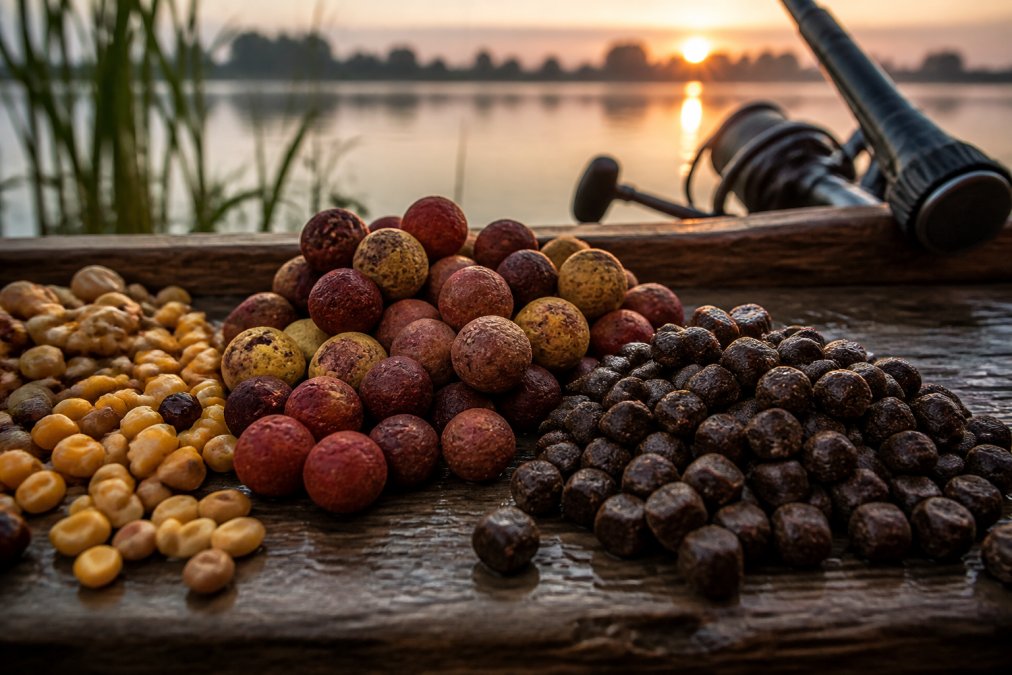
Boilies remain the benchmark for the best boilies for carp because they combine a slow leak rate with genuine food value, and they resist small fish far better than soft baits. A well-made boilie keeps working for hours after it hits the lakebed.
Broadly, boilies fall into three groups. High-attract versions release flavour fast and suit short sessions and pressured day-ticket waters. High-food versions rely on nutritional content and reward repeat visits, which makes them the better choice for baiting campaigns. Balanced shelf-life boilies sit in the middle and cover most situations competently.
Presentation matters as much as recipe. A trimmed-down boilie or a small dumbbell fished on a hair rig presents a low-resistance hookbait that carp can pick up without feeling the hook. Match the hookbait size to the free offerings you're introducing; a 16mm hookbait over 10mm freebies looks wrong and gets treated with suspicion.
How to Prepare Particle Bait for Carp
Learning how to prepare particle bait for carp is mostly about patience and hygiene, because undercooked particles are genuinely harmful to fish. The process is straightforward once you've done it a few times.
- Soak the particles in fresh water for 24 to 48 hours, changing the water at least twice.
- Drain and rinse until the water runs clear.
- Simmer in fresh water until the seeds soften through, typically 20 to 40 minutes depending on the particle.
- Cool completely before bagging, then refrigerate and use within a few days.
- Freeze any surplus in session-sized portions for later trips.
Tigers, hemp and maize are the staples, and each behaves differently. Hemp is a superb attractor but poor as a hookbait on its own, so most anglers fish it as a carpet beneath a boilie or a tiger nut hookbait. Maize is cheap, visual and reliable in coloured water.
Carp Fishing Baiting Strategies
Effective carp fishing baiting strategies come down to matching how much bait you introduce to how many fish are likely to find it. Overbaiting a low-stock water is the single most common reason for blank sessions (anglingtrust.net).
On short day sessions, a handful of freebies around a single hookbait is usually enough. On longer campaigns, building a swim over several days with consistent quantities teaches carp to associate a specific area and bait with food. Spodding and spombing let you place bait accurately at range, while a bait boat or throwing stick suits closer work.
The key variable is pressure. On heavily fished venues, carp have seen every mainstream bait and rig, so scaling down hookbaits, using matching freebies and keeping disturbance low matters more than the recipe itself.
This is where record-keeping earns its place. Logging bait type, quantity, swim and conditions after each session turns guesswork into a pattern you can act on. My Carp Pal's digital journal was built for exactly this, letting you track waters and record rigs so you can see which combinations actually produce repeat results across different venues.
Choosing the Best Carp Bait for Different Seasons
Season drives bait choice more than most anglers admit. Cold water slows a carp's metabolism, so winter fish want small, highly digestible, low-oil baits and very little of them (cefas.co.uk).
- Winter: small boilies, single hookbaits, minimal free offerings, strong attractors
- Spring: rising food value, particles and pellets as fish begin feeding properly again
- Summer: larger beds of bait, high-food boilies, particles used freely
- Autumn: heavier baiting as carp feed hard before temperatures drop
Water temperature matters more than the calendar. A mild autumn fishes like late summer, and a cold snap in April shuts fish down. Checking temperature rather than the date keeps you honest.
Common Mistakes When Selecting Carp Bait
Most bait mistakes are strategic rather than product-related. Anglers change bait too often to identify what's working, or copy a venue-specific approach onto water where it doesn't apply.
- Chasing trends instead of testing one bait properly over several sessions
- Ignoring water temperature and fishing summer tactics in winter conditions
- Overbaiting low-stock or heavily pressured venues
- Mismatching hookbait size to free offerings
- Failing to record results, so good sessions can't be repeated
The fix for all five is the same: change one variable at a time and write down what happened. Anglers who log sessions consistently spot patterns that occasional record-keepers miss entirely.
| Mistake | Fix | Why It Matters |
|---|---|---|
| Chasing trends | Test one bait over several sessions | Isolates what actually works |
| Ignoring water temperature | Check temp, not the calendar | Cold water changes feeding behaviour |
| Overbaiting | Match quantity to fish stock | Excess bait kills confidence |
| Mismatched hookbait | Match hookbait to freebies | Odd-one-out baits get avoided |
| No records | Log every session | Patterns only emerge from data |
Conclusion
Choosing bait without recording what you've tried is the fastest route to repeating the same blanks. My Carp Pal gives you a digital journal built specifically for carp anglers, with tools to track waters and record rigs so every session feeds into the next. You can also pick up quality merchandise built to last, though the journal works perfectly well on its own. Get started with My Carp Pal and turn your session history into a genuine catch-rate advantage.
Frequently Asked Questions
What is the most effective bait for carp fishing?
There is no single most effective bait for carp fishing; it depends on the water, season, and carp behaviour. Boilies are popular for their durability and ability to target bigger fish, while particles like sweetcorn and tiger nuts work well in warmer months. Pellets are excellent for introducing lots of bait. The best approach is to carry a range and let the carp tell you what they want on the day.
Do carp prefer boilies or sweetcorn?
Carp eat both, but their preference shifts with conditions. Boilies are high in protein and ideal for year-round fishing, especially for bigger carp. Sweetcorn is a classic particle bait that releases attractive sugars and is deadly in summer when carp are actively feeding. In heavily pressured waters, a single grain of sweetcorn on a hair rig can outfish a boilie because carp have seen too many boilies.
How do I choose the right carp bait for different seasons?
In cold water, carp digest slowly, so smaller, highly digestible baits like small boilies or single particles work best. As water warms in spring and summer, carp feed more aggressively and respond to larger baits, including multiple particles and pellets. In autumn, carp need to build fat reserves, so high-protein boilies and nuts are effective. Always match your bait size and type to the carp's metabolic rate.
Is it better to use homemade or shop-bought carp bait?
Both have merits. Shop-bought baits offer consistency and convenience, with proven recipes that work across many waters. Homemade baits let you tailor ingredients to specific venues and can be cheaper in bulk, but they require time and experimentation to get right. Many anglers use shop-bought boilies as a base and boost them with homemade glugs or dips for an edge.
0 comments