

Table of Contents
- Why Digital Carp Fishing Journals Beat Paper Logbooks
- What a Digital Journal Does That a Notebook Cannot
- How to Keep a Fishing Log That You Actually Stick To
- Tracking Water Temperature and Carp Activity Across Sessions
- What to Look For in the Best Carp Fishing App
- Your Data, Your Records: Privacy and Long-Term Storage
- Conclusion
- Frequently Asked Questions
Last Updated: September 25, 2026
Why Digital Carp Fishing Journals Beat Paper Logbooks
A digital carp fishing journal is a mobile record of every session, storing catch data, rig setups, water conditions and weather in a searchable database rather than a paper notebook. At My Carp Pal, we provide a dedicated digital journaling app, complemented by a curated range of high-quality apparel and accessories, specifically for serious carp fishing enthusiasts. The benefits of digital carp fishing journals show up fastest in one place: pattern recognition. A paper logbook can hold years of sessions, but it cannot tell you that you catch more fish on a falling air pressure with a hinged stiff rig in late autumn. A digital one can.
That distinction matters more than most anglers admit. You already remember the big fish. What you forget is the ordinary session that quietly repeated a winning formula, and the run of blanks that shared one variable you never noticed.
What a Digital Journal Does That a Notebook Cannot
A notebook stores facts. A digital journal interrogates them. That is the whole difference, and it is why the best carp fishing app feels less like a diary and more like a scouting report you compile without realising it.
The features that do the heavy lifting are unglamorous:
- Session history by water: every trip tagged to a venue, peg and date
- Rig and bait records: hooklink material, hook size, presentation, bait type and quantity
- Condition capture: air and water temperature, pressure trend, wind direction, cloud cover
- Catch detail: time of bite, fish weight, and which rod it came on
- Search and filter: isolate every session that matched a given combination
Patterns You Only See Once the Data Stacks Up
Ten sessions tell you nothing. Forty sessions across two years tell you that your bites cluster in a two-hour window after a pressure drop, or that a particular peg only produces when the wind pushes into the far bank. Those are the observations that change how you fish, and they are invisible on paper because flicking through 40 handwritten pages comparing wind directions is a job nobody does twice.
How to Keep a Fishing Log That You Actually Stick To
The single biggest reason fishing logs fail is delay. Log the session at the bank, not three days later, because recall decays fast and a log you reconstruct from memory is a log full of gaps. Every angler who has tried and abandoned a paper diary has failed at the same step: the entry was too slow, too cold, or too far from the bank.
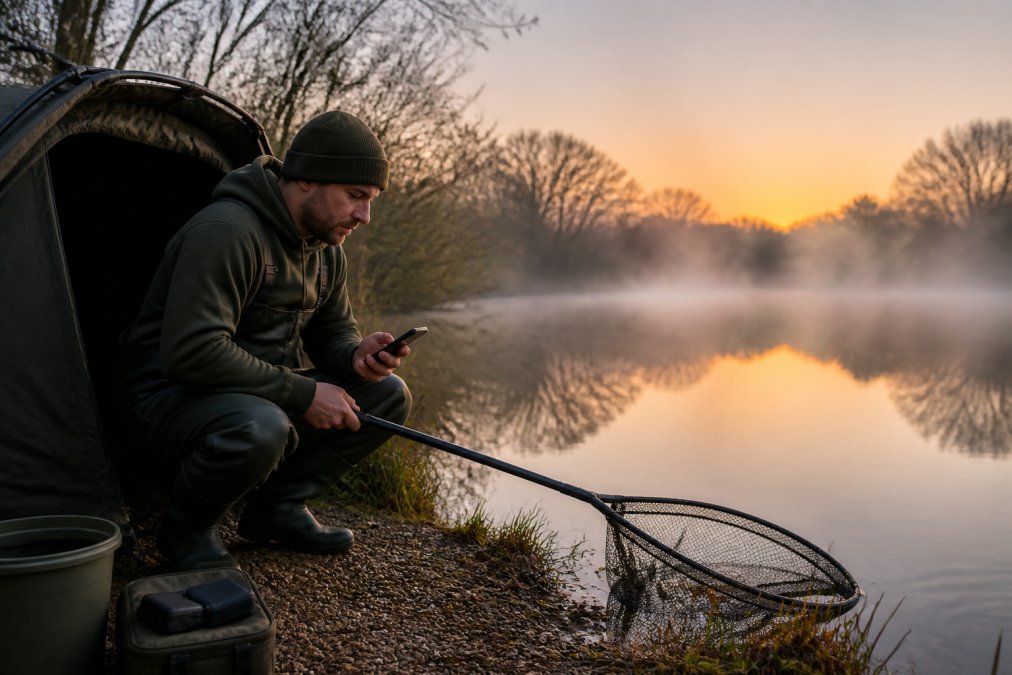
Log It at the Bank, Not Three Days Later
A workable routine takes under two minutes per fish and under five minutes per session. Set it up once, then repeat it:
- On arrival: log venue, peg, air temperature and wind direction
- After setting up: record water temperature and rigs on each rod
- On each take: note the time, the rod, and the rig that produced it
- At packing up: add bait used, total fish, and one line on what you would change
- Before the next trip: check what worked at that water last time
Tracking Water Temperature and Carp Activity Across Sessions
Water temperature is the variable most carp anglers under-record, and it is often the one that explains the most. Tracking water temperature and carp activity across sessions turns a vague sense that "the fish switched off" into a specific, dated observation you can act on next year.
Record water temperature at the same depth and the same time of day each session, or the numbers stop being comparable. Then pair it with what actually happened: bites, fish landed, and the hours they came in. Over a season, most anglers find their catch rate clusters into narrow temperature bands on their own waters, and those bands rarely match the general advice printed in magazines.
| What to record | Why it matters | When to capture |
|---|---|---|
| Water temperature | Explains activity windows | On arrival and at dusk |
| Air pressure trend | Rising, falling or stable | On arrival |
| Wind direction | Shows where fish push | On arrival |
| Bite times | Reveals feeding windows | At each take |
| Rig and bait | Links presentation to results | At setup and each change |
What to Look For in the Best Carp Fishing App
The best carp fishing app for you is the one that records what you actually want to know and survives years of use. Features matter less than three things: speed of entry, quality of search, and whether your data stays yours.
Judge any app against this list before committing:
- Entry speed: can you log a fish in under a minute, one-handed, in the dark?
- Carp-specific fields: rig, bait and water temperature, not generic "notes"
- Multi-water support: separate records per venue, comparable across venues
- Search and filtering: combine conditions, rigs and results in one query
- Export and backup: can you get your records out if you leave?
- Offline logging: bankside signal is unreliable, so entries must save locally
Your Data, Your Records: Privacy and Long-Term Storage
Your session history is the most valuable thing you will build as an angler, and it should outlast any single app. Under UK data protection law, you have the right to access, export and delete the personal data a service holds about you, and any reputable provider should make that straightforward rather than something you have to fight for.
Ask two questions before you commit years of records to any platform. Can you export everything in a usable format, and what happens to your data if the service closes? A journal you cannot take with you is a journal you do not own. At My Carp Pal, we focus on preserving angling memories, which matters when the whole point is preserving seasons of fishing you will want to look back on.
Conclusion
The hard part of keeping a fishing log was never the writing. It was the discipline of doing it every session and the patience to spot the pattern months later. That is exactly the work a digital journal takes off your hands, and it is why the benefits of digital carp fishing journals compound rather than fade.
My Carp Pal was built for serious carp anglers who want their sessions to mean something beyond the day itself. The app tracks your waters and records your rigs, keeps your session history in one place, and preserves the moments worth remembering alongside the data that produced them. Quality merchandise is there if you want it, but the journal stands on its own.
Get started with My Carp Pal and turn every session into something you can learn from.
Frequently Asked Questions
Why should I use a digital fishing journal instead of a paper one?
A paper log tells you what you caught. A digital carp fishing journal tells you why. You can search every session by water, rig, bait or temperature in seconds, and the app spots patterns across seasons that no notebook can surface. Entries are time-stamped, backed up and never lost to rain or a forgotten pen. If you fish several waters, having every record in one searchable place changes how quickly you learn.
What data points are most important to track in a carp fishing log?
Record water temperature, air temperature, wind direction and speed, barometric pressure trend, peg or swim, rig and hookbait, baiting approach, time of each take and the size of each fish. Water temperature and pressure trend carry the most weight for carp behaviour. Add a short note on what you changed and why. Those notes turn a list of catches into a decision-making record you can act on next session.
Can a digital fishing app help me catch more carp?
It will not put fish on the bank by itself, but it removes guesswork. Once you have logged enough sessions, you can see which rigs produced at which temperatures, which pegs fished best on a south-westerly, and whether your baiting was too heavy for the conditions. That is the point of tracking water temperature and carp activity together: the pattern is only visible when the data is in one place.
Are digital fishing journals easy to use during a session?
The good ones are built for one-handed use in the dark. Logging a take should take under a minute: fish weight, rig, time and a quick note. If an app needs more than that mid-session, you will stop using it by week three. Test any app on a wet, cold session before committing. Anything that pulls you away from the rods for long is not worth the effort.
0 comments